

The collector car market shifted dramatically at the start of 2026 – and the numbers make difficult reading if you didn’t already own one of these cars.
At Mecum’s Kissimmee sale in Florida in January, a 2003 Ferrari Enzo crossed the block for $17,875,000. The previous world record for the model, set in 2023, was $5.87 million. The average price across five Enzo sales in the first quarter of 2026 was almost $12.7 million, compared to $4.3 million for the five sold across all of 2023. The analogue supercar investment case had been debated for years. In 2026, the market has delivered a verdict.
What happened to supercar prices in early 2026?

[Image: Ferrari Enzo]
Mecum Kissimmee 2026 will likely be remembered as one of the most remarkable Ferrari events in recent years – not just for the number of records broken, but for what it revealed about shifting collector tastes.
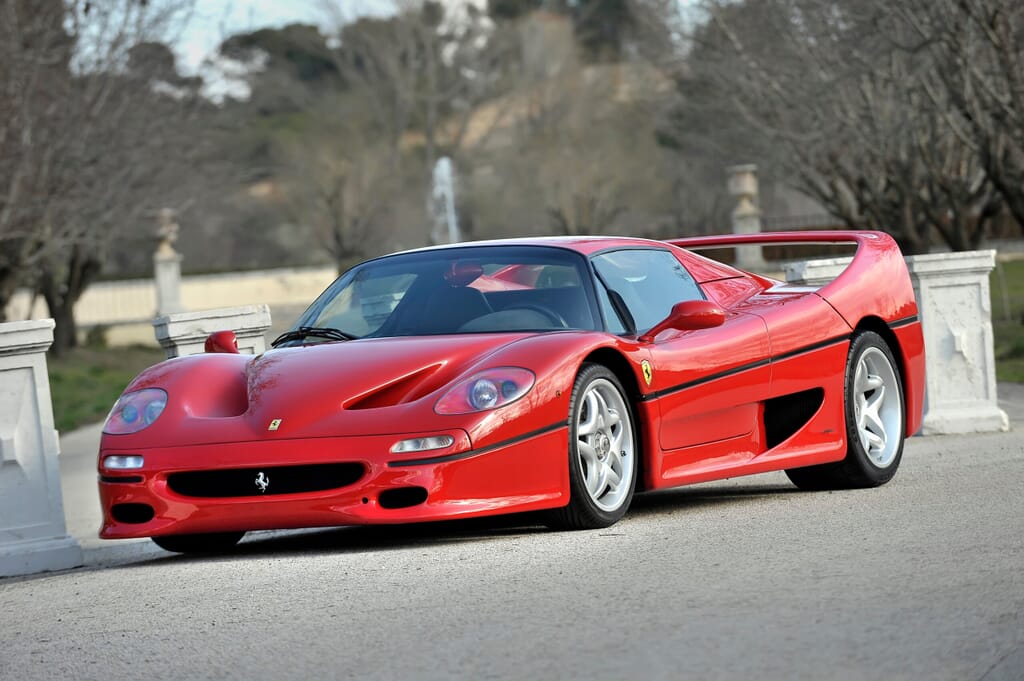
The Enzo was not the only story. A 2005 Porsche Carrera GT sold for $6,715,000 – doubling its previous record. A 1988 Porsche 959 Sport achieved a new record at $5,505,000. A 2017 Ferrari F12tdf, showing fewer than 100 miles, sold for $4,185,000, setting a new auction benchmark for the model. The Ferrari F50, which had traded steadily between $5 and $5.5 million since 2022, reached $9.245 million and then $12.21 million.
Closer to home, the Ferrari 458 Speciale – a car that could be found for under £250,000 relatively recently – has seen prices rise by nearly 29% in a single year, with well-kept European examples now trading at €800,000–€900,000. The 458 Speciale Aperta, 430 Scuderia, and 360 Challenge Stradale have all seen dramatic rises, some exceeding 150% over three years.
Why are analogue supercars rising in value?
[Image: Ferrari F50]
The cars commanding these prices share something fundamental: they belong to an era that is now under a different kind of pressure than it was five years ago. The Enzo, the F50, the Carrera GT, the 458 Speciale – these are the last of a lineage built around mechanical purity, naturally aspirated engines, and an unmediated connection between driver and machine. The Enzo in particular represents one of Ferrari’s last truly analogue supercars – a 6.0-litre naturally aspirated V12 paired with an F1-style gearbox, delivering a raw and direct driving experience that stands in contrast to today’s hybrid-assisted hypercars.
That distinction now matters in a way it did not a decade ago. The electrification of the automotive industry has not just changed what new cars are – it has permanently reframed how collectors value what came before. The arrival of the Ferrari Luce – unveiled in Rome this week as Ferrari’s first fully electric production car – only reinforces the point. Ferrari is now unambiguously a multi-energy company. That doesn’t make the naturally aspirated era obsolete, but it does make it increasingly singular.
Ferrari’s own ultra-restricted sales policies for its most exclusive new models have made the supercars and hypercars of previous years look like better value. For a collector who cannot secure an allocation for a limited-edition current model, acquiring an Enzo – increasingly recognised as a defining moment in Ferrari’s history – is not a compromise. It may be the more interesting decision.
Are collector cars a safe haven in uncertain markets?
The economic context matters here. Gold has risen nearly 50% in six months, and wealthier investors appear to be moving toward tangible assets – including multi-million-dollar supercars – as the broader economic outlook remains uncertain. Stock market volatility has historically driven capital into hard assets. Collector cars – straightforward to transact and often outside the scope of gains tax — have become increasingly attractive to those seeking alternatives to equities.
Hagerty’s data reflects this precisely. For vehicles valued under $250,000, requests to increase insured values have been recorded only once in the past 15 months. For high-end vehicles, the ratio has risen eight times in the same period. John Temerian of Miami supercar dealer Curated puts it plainly: the analogue supercar market “appears immune to broader economic jitters,” driven by passion and scarcity rather than short-term speculation. Many collectors, he notes, are doubling down on “forever cars that are truly irreplaceable.”
What makes a collector car a serious asset?

Supply constraint is structural, not cyclical. Previous collector car booms – the late 1980s, the post-2008 recovery, the COVID surge – were followed by corrections, partly because cars that had risen sharply could be replaced by others in the market. The analogue supercar category is different. No more will be made.
The strongest investment cases continue to sit with the Enzo, F50, 288 GTO, Speciale Aperta, and Challenge Stradale – particularly ultra-low-mileage, rare-colour, Ferrari Classiche-certified examples. The important qualification: 2026’s record numbers were boosted by museum-quality collections. Average examples will not automatically trade at peak levels.
Condition, provenance, and documentation are not peripheral considerations. They are now central to value. A car stored carelessly, serviced without specialist knowledge, or allowed to accumulate mileage without regard to its rarity, is categorically a different asset from one that has been properly cared for since new.
Caring for cars that matter

At Windrush, we look after cars of this calibre – Enzos, F12tdfs, Carrera GTs, 458 Speciales – with a clear understanding that they are no longer simply performance machines. They are irreplaceable assets, and increasingly, they are being treated as such by the market.
The attention we bring to preparing, storing, and returning each car reflects that understanding. For collectors navigating a market that has moved decisively in the past twelve months, the starting point is knowing exactly what you have – and that it is being looked after accordingly.



