
The rising interest in modern classic sports cars from the 2000s has come along as quickly as the 1990s icons before it. And it’s happening for much the same reasons, with the decade’s output packed with cars offering enormous driver appeal yet also the kind of ability, comfort, and reliability that doesn’t rule out far more regular use than cars from earlier decades. At the same time, hindsight has shown us that the encroachment of technology since the 2000s hasn’t necessarily been a positive thing for driving enthusiasts, leaving cars of that period feeling almost simple and stripped back.
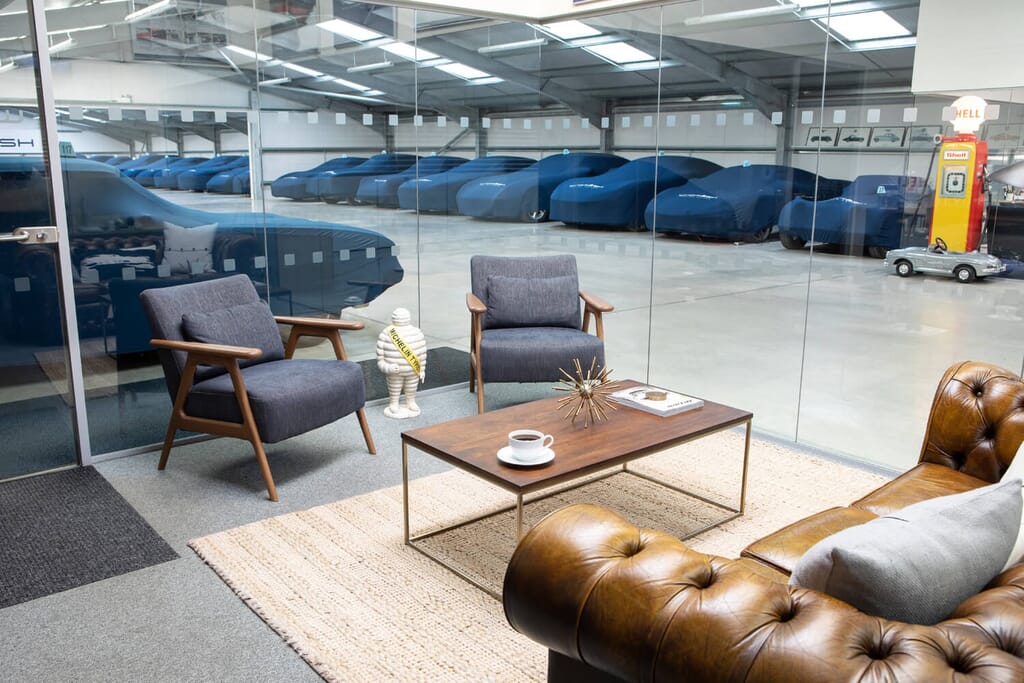
They might then be the perfect all-rounders: great to drive and own yet now at a point where values are no longer falling, but in some cases steadily rising. Those with fond memories of the cars when new are in a position to finally own, cherish and drive them, and as we’re conscious of here at Windrush, that usability makes proper preparation and storage between drives all the more important.
What makes a car a modern classic sports car?
Below is a selection of cars that set the standard for sports cars launched in the 2000s – each of which neatly walks that balance between usability and collectability that marks them out as something truly special.
Porsche 997

Ferrari F430

While the F430 can’t claim to be the last naturally-aspirated V8 mid-engined Ferrari it does have one big point in its favour compared to the more exotic 458 Italia that followed. We’re talking about a manual gearbox, making the F430 the last in its line to be available with Ferrari’s traditional open-gated shifter. It was a rarely-chosen option – it’s no surprise Ferrari moved away from manuals entirely shortly after – and today manual values are in another stratosphere to F1 ‘box cars, but for some drivers there’s simply no substitute.
It also has a distinct character from later mid-engined Ferraris. Its proportions give it a wieldy feel, despite (like the relationship between 997 and 991 Porsches) the tape measure showing only small differences between F430 and 458. Some will appreciate that those proportions mean the F430 can even look quite subtle, in the right colour – a little less in-your-face than a 458, 488, and others.
Yet the V8 is anything but subtle, especially in 503bhp Scuderia form. These are another leap again in values (the market long ago cottoned onto the worth in Ferrari’s more extreme road-going variants) but the Scuderia transcends that F1 gearbox for an experience that’s as intense today as it was back in 2007. Much of the F430’s appeal in general is in that slightly raw feel lost in later cars, while still originating in an era when Ferrari was really beginning to nail quality, finish, and serviceability.
Audi R8

Few cars have challenged the Porsche 911’s status as the definitive, every-day sports car like the Audi R8. Depending on who you ask, the R8 didn’t just give the 911 a hard time but really kicked mud in its face, with handling, performance and pure want-one desirability that even the 997 struggled to match.
That examples of the R8 can still be surprisingly affordable is a sign of how successful the model was for Audi – there are always plenty to choose from on the market. Nor is it a sports car that needs babying, built from corrosion-resistant aluminium and with mechanical components that, if looked after, are quite happy in daily use. If anything, the R8’s easy-going nature made it less 911 competitor and more modern-day Honda NSX.
It’s not short of performance in a modern context either, the dry-sumped 4.2-litre V8 making 414, and benefitting from all-wheel drive and a relatively modest 1.5-tonne kerbweight. If there’s a focal point to the R8 experience though, it’s not even the beautifully fluid handling, but the Ferrari-style open-gate manual transmission, whose tactile ‘clack’ into each ratio is one of the defining automotive pleasures of the 2000s.
BMW M3 (E90/92)

Another sign that mainstream performance cars were probably at their peak in the 2000s was that for a time, not just one but four manufacturers in the UK market alone offered relatively compact, V8-powered sports saloons: Audi with its RS4, Mercedes-Benz with the C63 AMG, the Lexus ISF, and the E90 BMW M3, which debuted in 2007.
Of the quartet the BMW was predictably the most driver-focused, powering its rear wheels through either a manual or a new dual-clutch gearbox, and with a quite remarkable engine. True to the spirit of the straight sixes and the inline-four of previous M3s, the ‘S65’ 4.0-litre V8 produced its 414bhp output all the way up at 8400rpm, more the preserve of Ferrari V8s than those found in a sports saloon.
Pumped-up styling carried over the muscle of the previous E46 M3 to the new body style, while the cabin took another step in the direction of luxury – but whether saloon or in ‘E92’ coupe form, the M3 was every bit a 911 rival. After a period where the sixes ruled the collector and performance car roost, the profile of the V8 M3s is growing fast, even ignoring the highly valuable GTS. The S65’s potential issues are well understood and easily fixed, and as the last naturally-aspirated M3s, and indeed the only V8s, interest is sure to grow even further.
Lamborghini Gallardo
The small Lamborghini had been a long time coming when the Gallardo arrived in 2003. The brand had offered models below its most bombastic mid-engined V12 models before – the Urraco, the Jalpa – but the entry-level slot had been bare since 1988. 1995’s Calà concept, by Italdesign, seemed feasible for a while, but ultimately we had to wait until 2003 for such a car to be realised.
It was worth the wait though. Related to the Audi R8 (that it would predate by three years) the Gallardo was a sign that Lamborghini was truly serious about competing in the sports car market, with an aluminium structure and all-new 5.0-litre V10 amidships, making close to 500bhp and revving to 8000rpm.
Luc Donckerwolke’s styling hasn’t aged a day: chiselled, compact (it’s just 4.3 metres long, shorter than a first-generation Porsche Boxster), yet confident and dramatic. By Lamborghini standards it was also comfortable, usable, and well-built – something new to most customers unless they’d already tried the larger Murcielago. Usability is something some Lamborghini diehards might dismiss as contrary to the brand’s ethos, but the Gallardo showed it could go hand-in-hand with drama and beauty.
Aston Martin V8 Vantage

Aston Martin as a business has long been a turbulent picture, making it all the more impressive that the brand has turned out so many brilliant cars over the years. We’re sure to look on the time under Ulrich Bez in the early 2000s as one of Aston’s high points though, not just for its relative stability but also for cars like 2005’s V8 Vantage.
Both to drive and to look at it’s one of the high points in Aston Martin’s timeline, against some tough opposition. The styling fit neatly underneath the Vanquish and DB9 launched in the years prior, but the Vantage had a dose of attitude to go with its beauty, courtesy of short overhangs, broad arches, and that sharp character line down its flanks that gave it a lean, toned look.
The V8 (first 4.3 litres, later 4.7) was one of Aston’s best too, with grit and brawn in equal measure and a racer’s roar when extended. It needs revs to work (the smaller engine more so) but the rewards are there when you do, especially matched to a snappy manual gearshift and with such a beautifully balanced chassis underneath. Best of all, the V8 Vantage has lost none of its kerbside appeal or usability; it is, as the popular saying goes, a car to make you feel like you’ve arrived.
Mercedes-Benz CLK AMG (C209)

[Image credit: Historics Auctioneers]
Mercedes had installed V8 power in its relatively compact C-Class as early as 1997’s C43 AMG, so by the time 2002’s CLK 55 AMG coupe came along, Affalterbach was really hitting its stride, yet these C209-generation AMG coupes (and convertibles) seem largely forgotten about. Perhaps it’s because the DTM and Black Series versions of the CLK tend to grab the headlines ahead of their narrow-bodied counterparts, but that doesn’t mean the regular CLK AMG is lacking in appeal.
For a start, the CLK’s V8s remain the stars of the show: a 367bhp, 5.4-litre naturally-aspirated unit from launch in 2002, and then from 2006, the 6.2-litre CLK 63 AMG with a full 481bhp. Both were automatic-only which possibly doesn’t help the CLK’s case as an enthusiast car, especially as this was no old-school wafter – precise responses and surprising feedback from the steering, plus excellent body control, make them as happy on a twisty road as they are sitting on the limiter on an Autobahn.
The curvy styling and connected ovoid headlamps are very of-their-era but the pillarless shape and five-spoke alloy wheels (a split 18-inch design on the 55, and thin spokes on the 63) are still handsome. They score on value too. Their relative affordability presents a risk when buying (not all will have been fastidiously maintained) but it’s also an encouragement to really get out and use these cars.
How should you store a modern classic sports car?
The cars above perfectly bridge the gap between collectability and genuine everyday usability, and if well maintained and looked after, will hold their appeal, and value, long into the future. At Windrush we have the experience to ensure cars like these are prepared and stored so that when you’re ready for the next road trip or spell of excellent weather, the car is ready to go as if you’d only been using it yesterday.