
Most supercar owners understand the obvious threats—stone chips, careless drivers, parking scrapes. What fewer appreciate is the silent, invisible enemy that can inflict far more expensive damage: humidity damage to supercars.
We’ve discussed climate control fundamentals before—the importance of temperature stability, the risks of dew point condensation, the balance between too much and too little moisture. What’s become increasingly apparent in the years since is just how vulnerable modern supercars are to these environmental factors, and how sophisticated climate-controlled car storage solutions need to be to address them.
Unlike everyday vehicles designed for daily exposure to the elements, supercars incorporate materials and construction methods that make them particularly vulnerable to moisture damage. The consequences aren’t immediate or dramatic, which makes them more dangerous. By the time visible damage appears, significant deterioration has already occurred.
Why Supercars Are Particularly Vulnerable
Modern supercars use extensive carbon fibre composites, magnesium alloys, and aerospace-grade materials chosen for performance rather than weather resistance. A McLaren 720S carbon tub, for instance, uses materials optimised for strength-to-weight ratio, not moisture tolerance. Ferrari’s aluminium spaceframes resist corrosion better than steel, but the dissimilar metals used throughout the vehicle create galvanic corrosion risks when moisture is present.
The electronics present another vulnerability. High-performance vehicles contain substantially more sophisticated control systems than conventional cars—often with hundreds of sensors, modules, and connectors. Humidity creates the perfect environment for contact corrosion, which manifests as intermittent faults that are notoriously difficult to diagnose. A condensation event in a footwell can result in thousands of pounds in diagnostic time and component replacement.
Interior materials compound the problem. Alcantara, full-grain leather, and carbon fibre trim pieces all respond poorly to fluctuating humidity. Alcantara can develop mould and discolouration. Leather loses its suppleness and can crack. Carbon fibre clear coats can delaminate. These aren’t minor cosmetic issues—they fundamentally affect vehicle value and, in some cases, structural integrity.
The Fundamentals Still Apply
The basic principles of climate control remain unchanged: temperature and humidity must both be controlled, not just one or the other. But the increasing sophistication of modern supercars has made precision more critical. The margin for error has narrowed as materials have become more specialised and values have risen.
A classic car from the 1960s or 70s, while valuable, was built with relatively straightforward materials—steel, rubber, leather, wood. These materials have been used in vehicles for decades, and their behaviour in various storage conditions is well documented. They’re tolerant of minor environmental fluctuations.
Contemporary supercars incorporate materials that simply didn’t exist in automotive applications twenty years ago. Carbon fibre monocoques, lithium-ion battery packs, nano-coated glass, electrochromic mirrors—each material has specific storage requirements. The tolerance for environmental variation is considerably lower.
The Real Cost of Humidity Exposure
The financial implications extend well beyond simple repair costs. A documented history of proper climate-controlled storage significantly influences resale value, particularly for limited-production models. Classic Ferrari and Porsche specialists increasingly require detailed provenance including storage conditions. A vehicle with incomplete storage history may face a 10-15% value penalty regardless of condition.
Insurance considerations matter as well. Policies for high-value collector vehicles often stipulate specific storage conditions. Humidity-related damage might not be covered if the vehicle wasn’t stored appropriately. Even when covered, the claims process can be lengthy, and vehicles may be written off rather than repaired when damage is extensive.
The time factor creates additional problems. Unlike accident damage, humidity-related deterioration isn’t always evident during routine inspections. Corrosion can progress for months or years before becoming visible. By that point, the damage has typically spread far beyond the initially affected area.
How Professional Climate Control Works

Effective dehumidified car storage involves more than simply running a dehumidifier. Professional facilities maintain specific parameters: typically 18-21°C temperature and 45-55% relative humidity. These figures aren’t arbitrary—they’re based on extensive research into optimal conditions for preserving various materials.
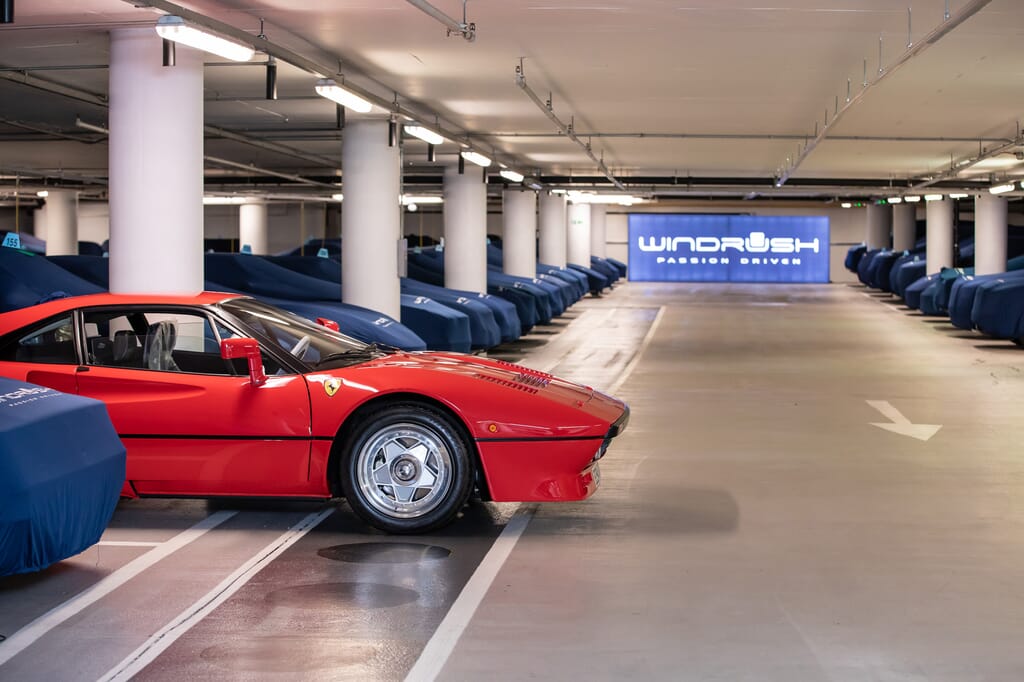
Different facilities achieve stability through different methods. Some control temperature, allowing humidity to stabilise naturally. Others—like Windrush’s Cotswolds facility—focus on humidity control, maintaining 55% relative humidity through active dehumidification regardless of temperature fluctuations. Both approaches can deliver stable conditions when properly implemented, with continuous 24/7 monitoring ensuring parameters remain within safe ranges.
The challenge lies in maintaining stability. While temperature fluctuations can cause humidity to vary, the critical factor is keeping moisture levels consistent. A facility might experience temperature changes from 15°C to 20°C, but if humidity remains at 55%, the risk of condensation and material damage is minimised. The relationship between temperature and humidity is complex—warm air holds more moisture than cold air—which is why simply heating a space doesn’t solve humidity problems and can actually make them worse.
When air temperature drops to dew point, the air becomes fully saturated. Any surface below that temperature will experience condensation, regardless of what the humidity gauge reads. This is why simply heating a storage space isn’t sufficient—warm air carries more moisture, and if that warm, moisture-laden air encounters a cold surface, condensation forms immediately.
Equally damaging are rapid temperature changes. Moving a vehicle from a heated storage facility into cold outside air causes rapid contraction of materials. The differential rates at which various materials contract—aluminium versus steel, carbon fibre versus paint—create stresses at joints and bonded surfaces. Repeated cycles accelerate fatigue and can lead to premature failure.
Professional systems address this through integrated building design rather than mechanical systems alone. Proper insulation prevents temperature cycling. Vapour barriers control moisture migration through building fabric. Air handling systems maintain consistent conditions throughout the space, eliminating the cold spots where condensation forms.
Monitoring systems provide the final layer of protection. Continuous data logging identifies trends before they become problems. If humidity begins to drift outside optimal ranges—whether from a roof leak, door seal failure, or mechanical issue—24/7 monitoring alerts staff immediately. Active dehumidification systems respond automatically to maintain that critical 55% relative humidity threshold, with human oversight ensuring systems are functioning correctly.
The 55% figure represents a carefully considered balance. Excessive humidity promotes corrosion and mould growth, but over-dehumidification creates different problems. Air that’s too dry causes leather to crack, dashboards to split, and wood trim to shrink and separate. Domestic dehumidifiers simply reduce humidity without maintaining a target level—they’ll continue drying the air until switched off. Industrial systems used in professional storage maintain rather than merely reduce, holding humidity at the optimal point for material preservation.
Climate stability can be achieved through different control strategies. Some facilities use thermal mass—large concrete structures that dampen temperature fluctuations, allowing humidity to stabilise naturally through consistent temperatures. Others focus directly on humidity control through active dehumidification, maintaining specific moisture levels regardless of temperature variations. This is the same principle used in wine cellars and museum archives. Both approaches work when properly monitored; what matters is preventing the humidity extremes that cause damage.
What Actually Happens to Your Vehicle

[Image – Alcantara leather can be costly to repair]
Understanding the mechanisms helps appreciate why prevention matters so much. Corrosion doesn’t begin uniformly across all metal surfaces. It concentrates at stress points, joints, and areas where different materials meet. An aluminium wishbone bolted to a steel subframe will corrode at the interface if moisture is present, even when both individual components remain unaffected.
Carbon fibre humidity damage follows a different pattern. The carbon fibres themselves don’t degrade, but the resin matrix that binds them is hygroscopic—it absorbs moisture from the air. Over time, this causes delamination between layers and loss of structural properties. Visual inspection won’t detect this until delamination is advanced, which is why condition monitoring during climate-controlled storage is important for carbon-intensive vehicles.
Electrical systems fail in subtle ways. Moisture on circuit boards causes electrolysis, creating microscopic shorts between traces. The resulting faults are intermittent initially—a sensor reading that occasionally drops out, a module that works perfectly during diagnostic testing but fails when the vehicle is driven. By the time the fault becomes consistent enough to trace, the affected component has typically degraded beyond repair.
Interior damage is often the most visible but least concerning from a structural standpoint. Nevertheless, the costs can be substantial. Re-trimming an Alcantara interior correctly requires specialist skills and materials. Leather that has developed mildew or permanent creasing cannot be restored—only replaced. Carbon fibre trim pieces with delaminated clear coat need complete refinishing.
Long-Term Storage Considerations
Vehicles stored for extended periods face additional challenges. Fuel system degradation accelerates in humid conditions. Modern fuel systems, particularly on turbocharged vehicles, contain numerous rubber and plastic components that degrade when exposed to moisture and ethanol-blended fuels. The result is blocked fuel filters, corroded injectors, and deteriorated fuel lines.
Brake systems present another concern. Brake fluid is hygroscopic, absorbing moisture from the air over time. In storage, this process continues even when the brakes aren’t being used. The moisture lowers the boiling point, creating a safety risk when the vehicle returns to service, and promotes internal corrosion of brake components.
Tyres require specific humidity conditions as well. Excessive moisture accelerates rubber degradation, leading to sidewall cracking and tread separation. The effect is particularly pronounced on high-performance tyres using softer compounds. A set of Pirelli P Zero Trofeo R tyres can develop cracks within months in poor storage conditions, even with minimal mileage.
Conclusion
Humidity damage to supercars isn’t dramatic or immediate, which makes it easy to underestimate. The mechanisms are well understood, the consequences are expensive, and the solution is straightforward: consistent climate stability with proper monitoring.
The materials and construction methods that make modern supercars extraordinary performers also make them vulnerable to environmental damage. Carbon fibre composites, aerospace-grade alloys, and sophisticated electronics all require stable storage conditions with controlled humidity levels. Understanding this relationship is essential for anyone who values their vehicle as an asset worth protecting.
Professional storage achieves climate stability through different approaches—active dehumidification systems that maintain precise parameters, or engineered passive solutions using thermal mass to prevent fluctuations. Both methods are valid when properly implemented and monitored. The difference between professional climate-stable storage and an uncontrolled garage environment can determine whether your vehicle appreciates or deteriorates over time.
Founded in 2004, Windrush operates specialist vehicle storage facilities in Central London and the Cotswolds. Our Central London facility uses engineered thermal mass for climate stability, while our Cotswolds facility actively maintains 55% relative humidity through dehumidification systems. Both locations feature 24/7 environmental monitoring designed specifically for high-value vehicle preservation.